German small and medium-sized businesses are under considerable pressure.
High costs. International competition. Shortage of skilled workers. Volatile markets. Rising customer expectations. Shorter development cycles. At the same time, pressure is mounting to submit bids faster, assess technical risks earlier, and bring new products into series production as smoothly as possible. This isn’t some abstract debate about Germany as an industrial hub—it’s everyday reality.
And for small and medium-sized businesses in the metalworking, sheet metal forming, toolmaking, and related industries in particular, a crucial question arises:
How can industrial value creation in Germany remain economically viable when complexity and cost pressures are rising simultaneously?
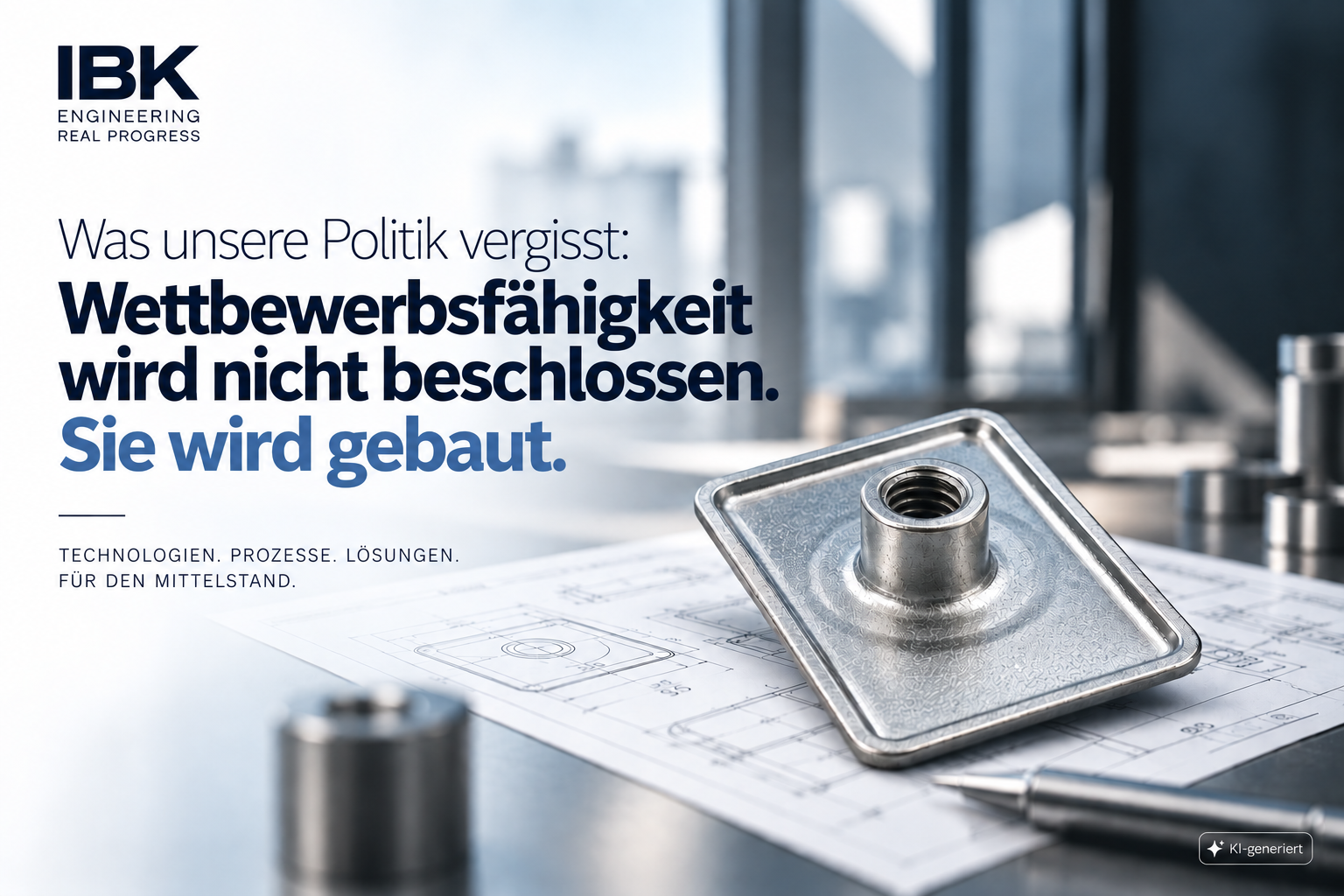
The answer to this question cannot be found in Berlin or Brussels alone, because competitiveness can be supported through policy measures.
It is being built
The real problem often isn’t the product itself
Many German small and medium-sized businesses develop outstanding products. They have experienced employees, in-depth manufacturing expertise, and decades of accumulated know-how. Yet valuable profit margins are lost as projects progress. Why?
Because problems often arise where responsibilities and technical disciplines intersect:
It’s not the obvious problems that end up costing the most. The problems that end up being the most expensive are, above all, those that become apparent too late. Examples include an unfavorable part geometry that is only noticed during tooling, a manufacturing assumption that proves critical only during the try-out, a tooling decision that seems cost-effective in the short term but later causes additional iterations, or technical risks that were already present during the bidding phase—but were not systematically assessed.
Then the familiar pattern begins: changes, coordination, rework, schedule delays, and additional costs—and in the end, what was supposed to be an affordable project turns out to be an expensive one.
This is exactly where competitiveness is determined
The key question, therefore, is not: How can we solve problems more quickly? Rather: How can we prevent avoidable problems from even reaching a costly project phase? That is a fundamental difference.
Companies that identify technical risks early on not only gain time, but also improve the quality of their decision-making—and it is precisely this quality of decision-making that becomes a decisive advantage in an increasingly global competitive environment.
Recent studies underscore the urgency of taking action: According to the ifo Institute, in the spring of 2026, about one in four industrial companies reported a decline in competitiveness in markets outside the EU. The proportion was particularly high in sectors such as mechanical engineering, metal production, and among manufacturers of metal products.
At the same time, KfW Research highlights an important lever: Small and medium-sized enterprises (SMEs) that continuously engage in research, development, and process innovation assess their future competitive position more positively. This means that SMEs cannot influence every location factor, but they can influence how intelligently they develop, industrialize, and produce.
Engineering shouldn’t wait until a problem becomes apparent to begin
This is exactly where IBK Engineering comes in. Our goal is not to provide companies with additional theoretical concepts. Our goal is to clarify technical relationships early on in a way that enables better decisions to be made. After all, every sound decision made before tool modifications, try-out cycles, or production problems arise is less costly than a correction made later on. To achieve this, IBK combines expertise in products, processes, and manufacturing.
Depending on the task at hand, factors such as component designs, manufacturability, forming processes, tooling concepts, technical interfaces, and potential weak points are considered. Digital methods and simulations can also help evaluate processes before committing actual resources. The goal: to reduce development times, increase process reliability, and avoid unnecessary material and tooling costs. This is not about digitalization for its own sake. A digital model only has value if it leads to a better real-world decision.
From a Technical Problem to Economic Benefits
For our customers, this means:
Early Risk Transparency: Critical issues are identified, whenever possible, at a stage when changes can still be made relatively easily and cost-effectively
You should be technically proficient.
Why IBK Engineering:
Because small and medium-sized businesses don’t need more presentations—they need solutions. That’s why IBK doesn’t see itself as a consulting firm that analyzes a problem, delivers a presentation, and then moves on to the next project.
Our approach combines consulting with engineering and a focus on implementation. It is precisely this commitment—analysis, technical evaluation, and support for practical implementation—that also defines IBK’s existing consulting approaches. We look not only at individual technical symptoms, but also at the interfaces where product, tool, process, supplier, time, and costs converge. That is where the greatest economic leverage often arises.
The IBK Weakpoint Check: Identify Problems Before They Become Costly
That’s exactly what the IBK Weakpoint Check is for.
The basic idea is simple: Don’t wait until a problem starts to cost you money. Look for vulnerabilities while there’s still room to act. Together, we examine critical technical issues and identify potential weaknesses in products, tools, processes, or project handoffs.
The result should not be a theoretical list of measures. The goals are:
For managing directors, technical directors, development managers, and production managers, this means one thing above all else: greater certainty before money and time are irrevocably committed.
Competitiveness doesn’t start with funding programs
Germany needs a competitive business environment—there’s no question about that—but companies can’t wait for all their energy, bureaucratic, tax, or labor market problems to be resolved through political means. International competition won’t wait either. That’s why we need to discuss the second part of the debate on Germany as a business location:
And the ability to identify technical risks earlier than the competition. Perhaps that is precisely one of the underrated strengths of German small and medium-sized enterprises— not just discussing problems, but solving them technically.
Conclusion
Government policy can establish the framework, and companies can ensure competitiveness. The sooner these decisions are made on a sound foundation, the greater the chances of lower costs, shorter development times, more stable processes, and successful mass-production launches.
Competitiveness isn’t something that’s decided—it’s something that’s built. IBK Engineering provides the engineering services for this.
How many technical risks are still lurking undetected in your next project?