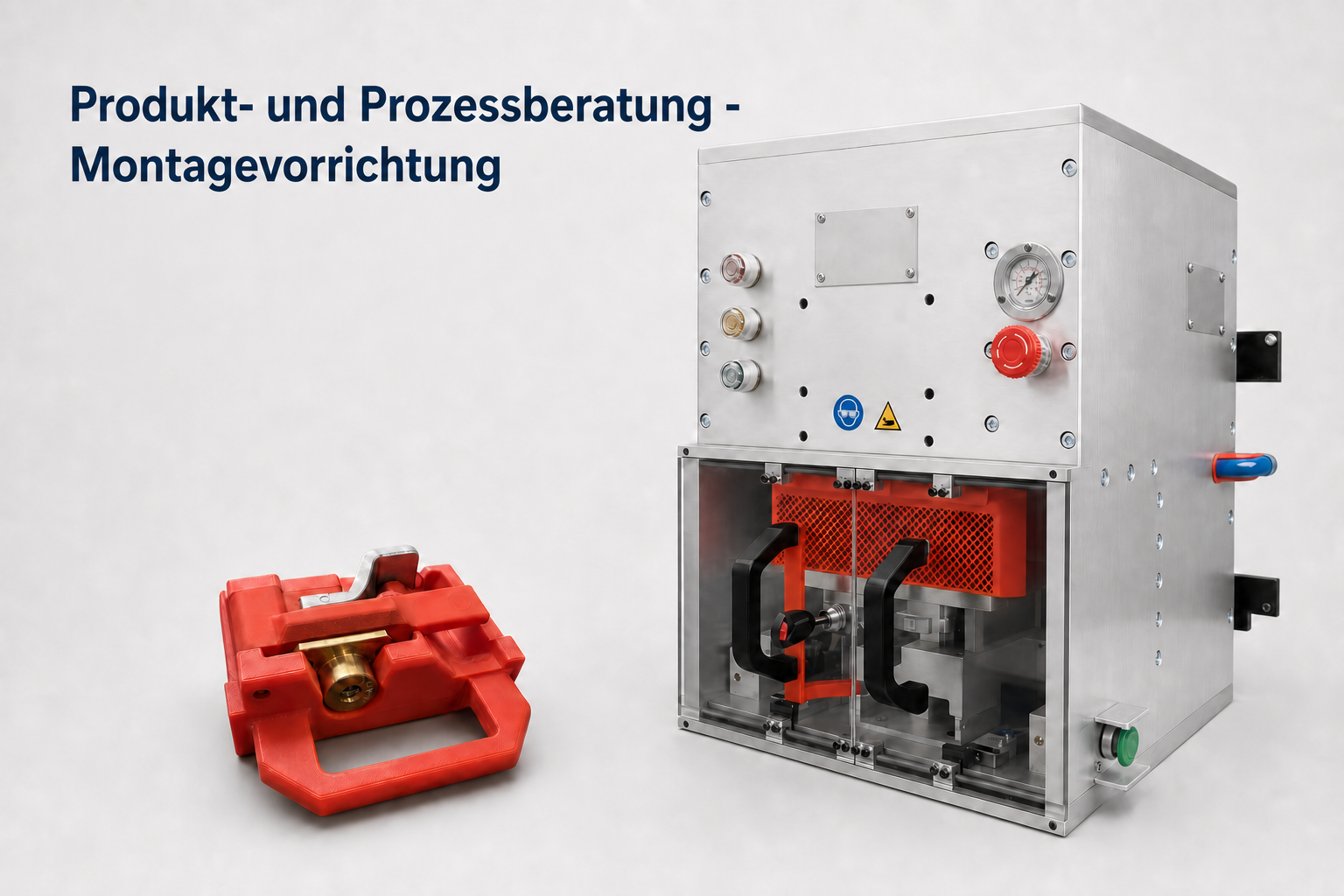
From 50–70% scrap to 90% OEE: How IBK Engineering transformed an unstable assembly process into a robust mass-production process. IBK bridges the gap between German engineering excellence and globally competitive manufacturing.
This was exactly the situation a client of IBK Engineering faced.
The existing assembly fixture did not reliably meet the requirements of the mass production process. Scrap rates of 50 to 70 percent in some cases, a high number of defective products, and recurring process interruptions negatively impacted quality, productivity, and the cost structure.
The main task, therefore, was not: How do we optimize a single device?
Rather: How do we turn an unstable assembly system into a robust, cost-effective, and scalable mass-production process?
IBK Engineering took responsibility for the entire technical clarification process—from a structured root-cause analysis through design reorientation to the validation and mass production of relevant components.
The Situation: High operational costs with limited process control
The existing assembly process was characterized by a combination of technical and organizational weaknesses.
The key impacts included:
- Rejection rates of up to 70 percent
- significant rework and testing costs
- inconsistent product quality
- low process stability
- Recurring machine and process interruptions
- increased error costs
- Lack of transparency regarding the actual causes
- Inadequate coordination between the device, components, and suppliers
The result was a process that, while carried out as part of day-to-day operations, was not adequately managed from a business perspective. For the customer, this meant not only operational friction but also a growing risk to delivery reliability, quality, and margins.
The IBK Approach: Stabilizing the Entire System Rather Than Correcting Symptoms
IBK Engineering began the project with a structured gap analysis.
The goal was to align the current state with the target state that is both technically necessary and economically viable.
The analysis did not focus solely on the assembly fixture. Instead, it examined the entire system of interactions comprising:
- Design and Construction of the Assembly Fixture
- Component Geometry and Component Condition
- Tolerance Chains and Tolerance Zones
- Process Parameters
- Material and Supplier Factors
- location-specific production conditions
- User Interaction
- Security Technology
- Assembly Function
- Quality and Testing Policy
This systemic approach was crucial. That’s because the errors did not occur at a single point, but rather at the interfaces between the product, the process, and the supply chain.
Key Findings
The analysis identified four key areas of concern.
1. Design Flaws in the Assembly Fixture
The device was not sufficiently adapted to the actual component conditions and the requirements of stable mass production.
Positioning, fixation, and force application did not reliably lead to reproducible results.
The design worked in principle—but it wasn’t robust enough for the realities of mass production.
2. Incorrectly defined or uncoordinated tolerance ranges
Although several components were within their specifications when considered individually, the selected tolerance ranges resulted in critical dimensional chains within the assembly.
This made it clear: A component that meets tolerance requirements does not automatically result in a functional assembly.
3. Lack of assembly validation
The interaction between the individual components had not been adequately validated under actual process conditions.
As a result, functional interactions between the device, active components, and assembly parameters were not taken into account.
4. Need for Safety-Related Adjustments
The existing facility not only needed to be made more efficient, but also brought up to current safety standards. IBK therefore combined process optimization and safety upgrades into a single comprehensive technical concept.
The Solution: Realigning Design, Tolerances, and the Supply Chain
Based on the analysis, IBK Engineering developed an integrated set of measures.
Design Optimization of the Assembly Fixture
The assembly fixture has been technically redesigned and specifically optimized for process stability, repeatability, and ease of use.
The focus was on:
- improved positioning
- defined component mounting
- secure fastening
- controlled force transmission
- reduced reliance on operators
- more consistent repeatability
- easier maintenance and handling
Adjustment of the Tolerance Policy
The tolerances of the relevant active components were reevaluated and adjusted to match the actual function of the assembly.
The goal was not to apply tighter tolerances across the board to every component. Instead, tolerances were optimized where they had the greatest functional impact on the assembly process. This resulted in a technically sound tolerance concept that combines quality and cost-effectiveness.
Subassembly Alignment and Validation
The revised solution was tested as a complete system. The benchmark was not the individual part, but rather the functional assembly.
This made it possible to:
- reliable functional validation
- robust process windows
- reduced error dispersion
- greater transferability to series production
- greater process reliability
Security Update
The safety-related redesign was integrated directly into the new design. This resulted not in a retrofitted add-on solution, but in a technically sound overall architecture that can be used over the long term.
Implementation within 12 weeks
From the initial analysis to the technically validated implementation, the project was completed within twelve weeks.
The project process followed a clear structure:
- Assessment of the Current Situation
- Conducting the Gap Analysis
- Prioritizing Technical Causes
- Revision of the Design and Tolerance Concept
- Coordination with Suppliers
- Safety Update
- Assembly Validation
- Commissioning
- Stabilization of the production process
The short implementation time was possible because decisions were based on sound technical knowledge and engineering, process optimization, and supplier management were closely integrated.
The Result: From Operational Friction to Measurable Value Creation
The technical measures led to a significant improvement in operational performance.
OEE Increased to 90 Percent
The optimized assembly device operates more reliably, with greater reproducibility, and with significantly fewer interruptions caused by errors.
Overall Equipment Effectiveness was increased to 90 percent.
For the customer, this means:
- higher system availability
- more good parts per shift
- less downtime
- more consistent cycle times
- better utilization of existing production capacity
Scrap and error costs significantly reduced
By systematically eliminating design-related, tolerance-related, and process-related causes, scrap and rework were significantly reduced.
The economic impact arises on several levels:
- lower material consumption
- less rework
- reduced testing effort
- fewer risks of complaints
- lower cost per unit
- greater delivery capacity
A stable and reproducible mass-production process
The assembly process was transformed from a reactive problem-solving process into a controlled mass-production process.
This achieves:
- Planning Certainty
- Cost Transparency
- Process robustness
- consistent quality
- scalable manufacturing
Customer Benefits at a Glance
1. Increased Productivity
By increasing OEE and reducing error-related interruptions, it is possible to achieve greater output with existing resources.
2. Lower manufacturing costs
Fewer rejects, less rework, and fewer downtime periods directly reduce the cost per good part.
3. Greater consistency in quality
The carefully coordinated combination of the fixture, components, and tolerances improves the reproducibility of assembly results.
4. Faster problem-solving
A structured gap analysis provides clarity on the actual causes and prevents costly trial-and-error cycles.
5. Lower risk of delivery issues and customer complaints
A stable process reduces the risk of late deliveries, quality issues, and escalations with end customers.
6. Improved Security
The safety upgrade reduces operational risks and improves the facility’s long-term usability.
7. A Stronger Supply Chain
By adjusting the tolerances and directly involving the relevant suppliers, the supply chain was stabilized from a technical standpoint.
8. A single point of contact for engineering and production
IBK Engineering was also awarded the contract to supply the relevant components in series production from its own supplier network.
As a result, the customer benefits from:
- fewer interfaces
- clear technical responsibility
- faster implementation of changes
- coordinated quality assurance
- long-term security of supply
From a Consulting Project to a Long-Term Partnership
The project did not end with the optimization of the assembly fixture.
Thanks to its technical expertise, rapid implementation, and measurable results, IBK Engineering was able to earn the client’s lasting trust.
In addition to process optimization, IBK was commissioned to supply relevant components for series production.
As a result, what began as an urgent improvement project turned into a long-term customer relationship.
This provides customers with a clear strategic advantage: engineering, process expertise, supplier management, and mass production—all from a single source.
The Strategic Value-Added
The project shows that competitiveness does not result solely from cheaper components or more powerful machines.
The key is to have a thorough understanding of the entire system.
IBK Engineering connects:
- German engineering
- Structured root cause analysis
- Practical Process Optimization
- Robust Tolerance Management
- Global Supply Chain Expertise
- production-ready implementation
This results in solutions that not only work from a technical standpoint but also have a measurable economic impact.
IBK Engineering – we don’t just optimize fixtures. We stabilize value creation.
From 50–70 percent scrap to 90 percent OEE.
From technical uncertainty to reliable mass-production capability.
From a one-time measure to a long-term customer partnership.
Your project in the best hands
At IBK Engineering, we combine technical expertise with state-of-the-art production technology. We offer our customers the best of both worlds: Innovation and reliability.
Do you have a project that we can support you with? Contact us, we will be happy to advise you!